
Vietnam Retail & E-commerce Q1/2026: Growth is Back, But the Retail Playbook Has Changed
Vietnam’s retail and e-commerce market entered 2026 with a stronger growth base. Manufacturing activity improved, retail sales continued to rise, and digital commerce remained one of the fastest-growing parts of the market.
But the key story of Q1/2026 is not simply that the market is growing.
The more important shift is that growth is becoming harder to capture. Consumers are more selective. Online platforms are playing more distinct roles. Content is becoming part of the purchase journey. Stores are no longer only points of sale, but points of trust, verification and service.
For Retail and FMCG brands, this means the 2026 playbook needs to move beyond channel expansion and promotion intensity. The next stage of growth will depend on how well brands connect content, commerce, physical stores, customer data and post-purchase experience.
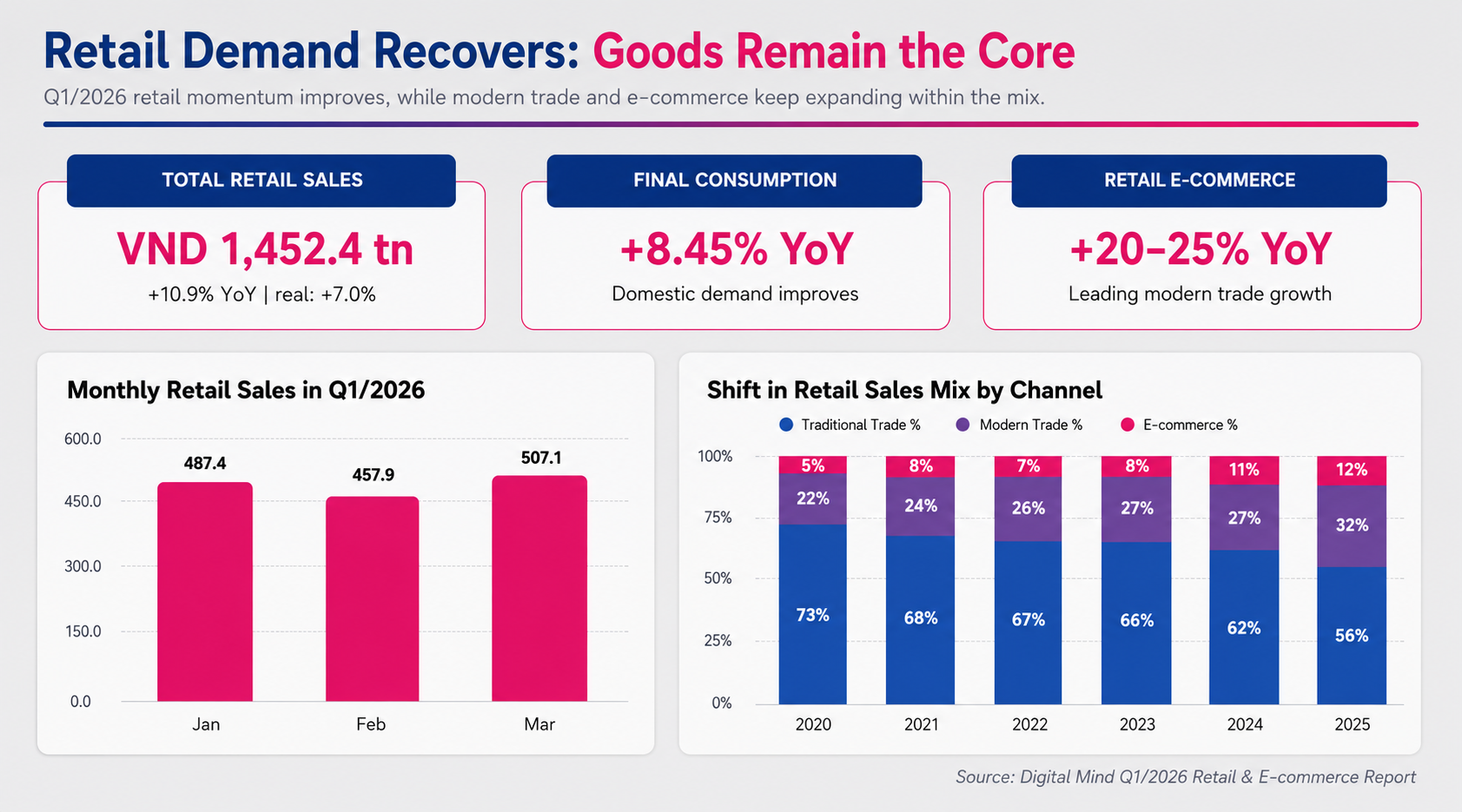
Retail demand is improving, but this is not a simple consumption boom
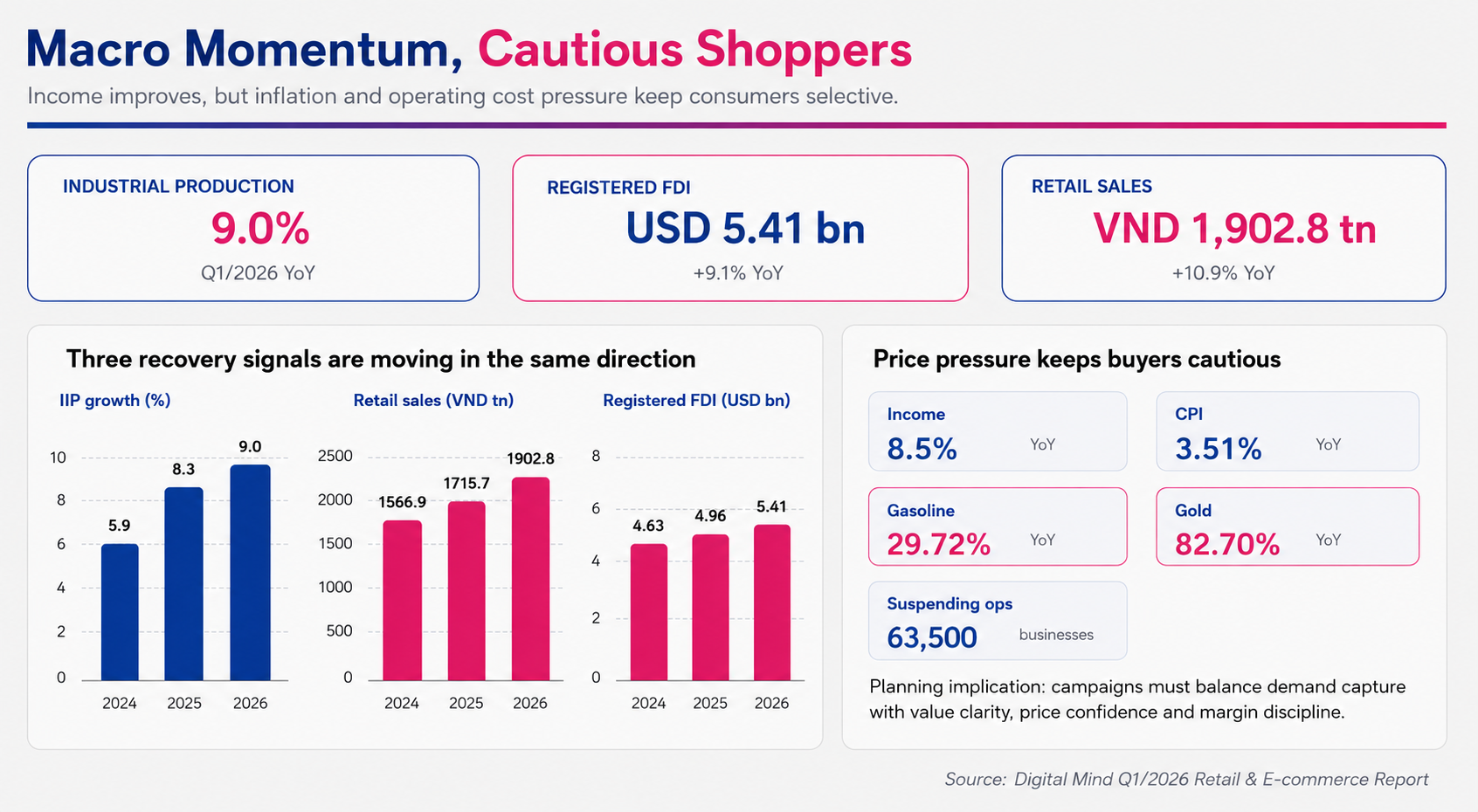
Vietnam’s Q1/2026 economy maintained positive momentum. Industrial production continued to recover, registered FDI improved, and total retail sales increased compared with the same period last year.
At the same time, consumers remain cautious. Income growth has improved, but inflation, fuel prices, high operating costs and a defensive financial mindset continue to affect spending behavior.
This creates a market where demand is still present, but consumers are more calculating. They are not necessarily cutting all spending, but they are more deliberate about what they buy, where they buy it and what value they expect in return.
For brands, this means growth cannot rely only on reach, traffic or discounts. The bigger question is how to make consumers feel confident enough to choose, pay, repeat and stay loyal.
E-commerce is no longer one single game
Vietnam’s e-commerce market continues to grow strongly, but the platform landscape has become more clearly divided.
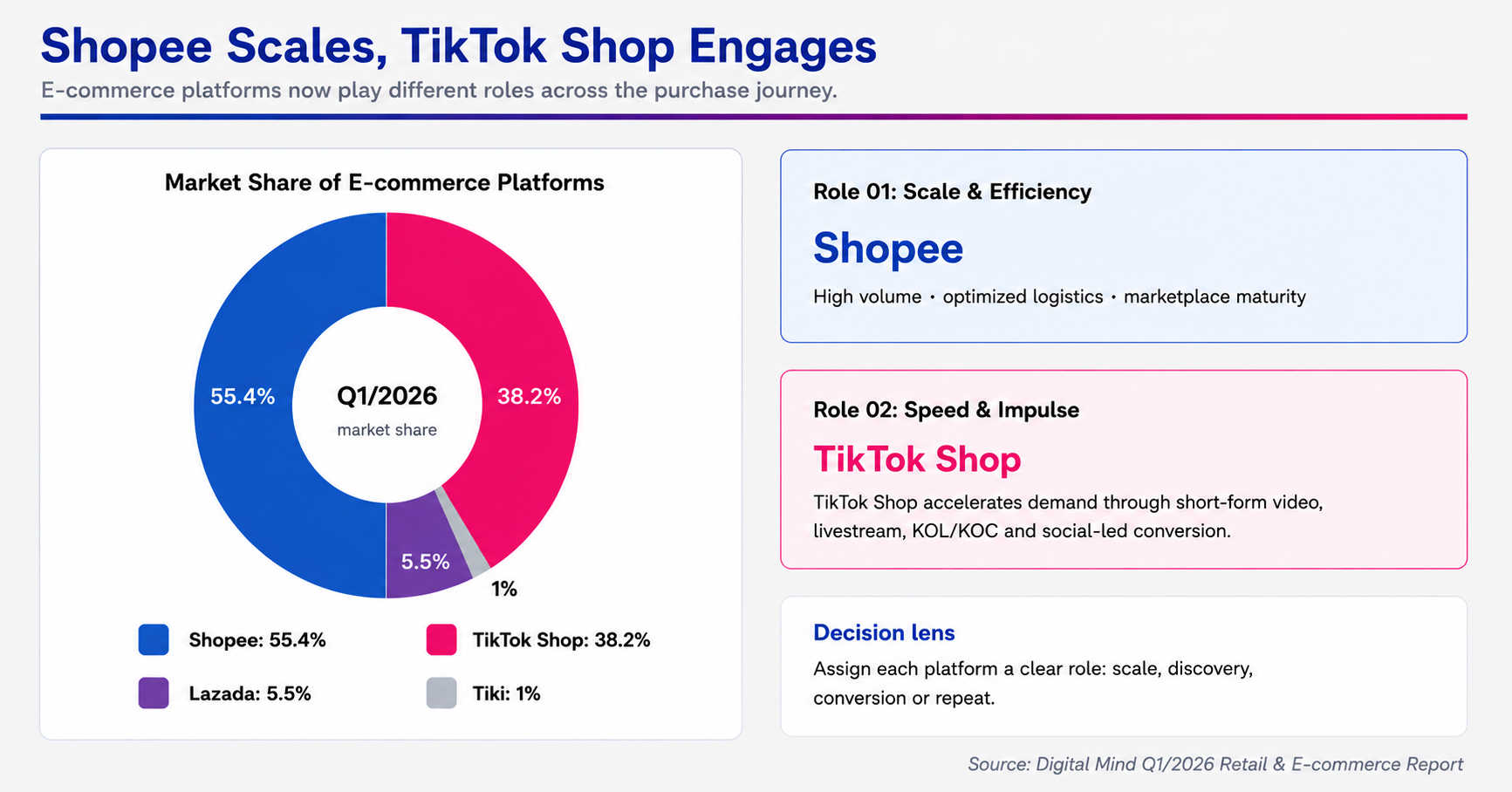
Shopee remains the scale platform, accounting for more than half of the market. It is strongest when brands need reach, volume, logistics efficiency and marketplace maturity.
TikTok Shop, meanwhile, is becoming the speed and impulse platform. Its strength lies in content-led discovery, short-form video, livestreaming, KOL/KOC influence and fast conversion.
This means brands should not treat marketplaces as interchangeable sales channels. Each platform needs a different role in the commercial model.
Shopee is where brands can build scale and operational efficiency. TikTok Shop is where brands can accelerate demand creation, product trial and social-led conversion. The winning model is not choosing one over the other, but assigning the right role, budget and content format to each platform.
Content has become the trust layer before conversion
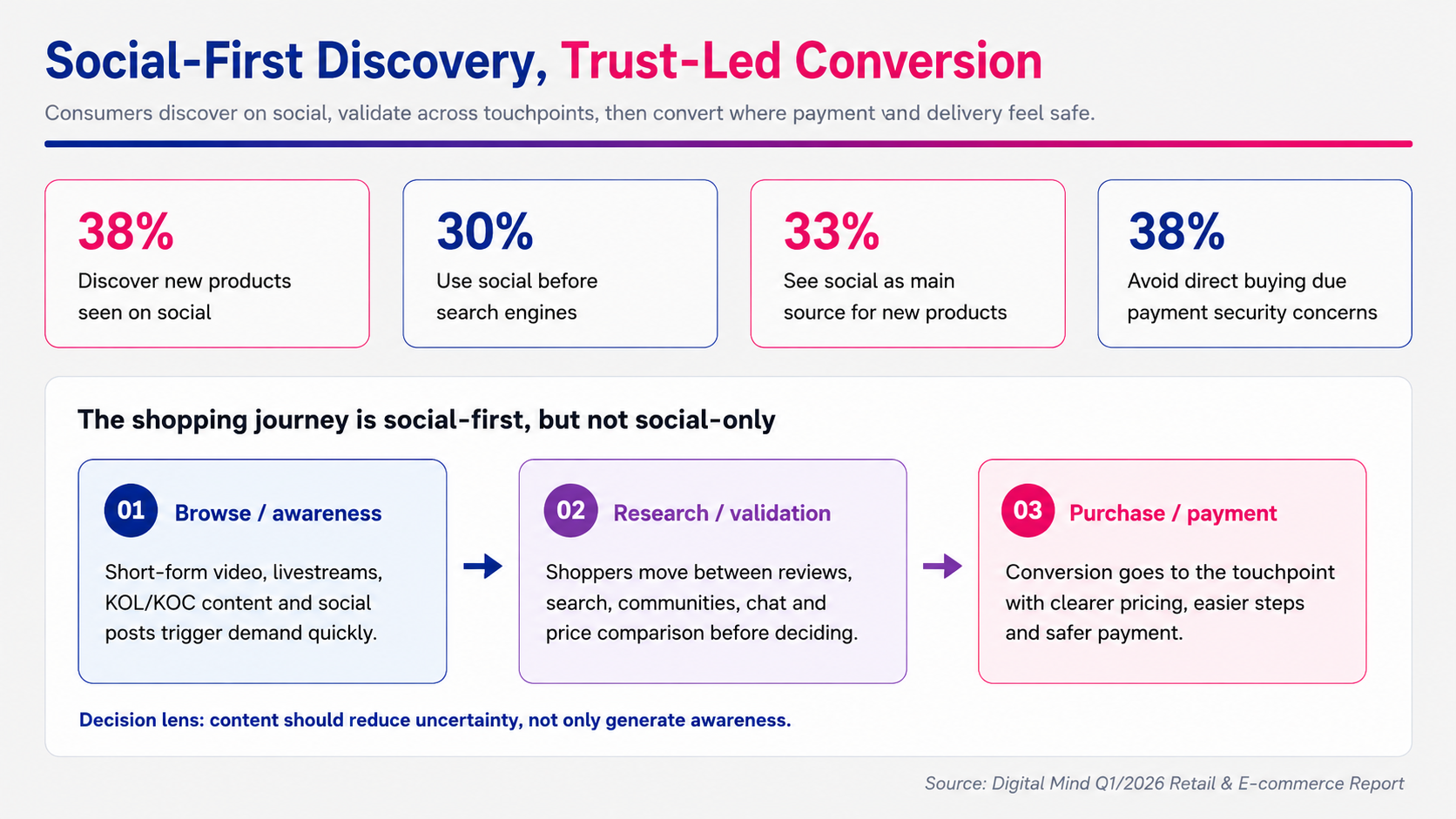
In 2026, consumers are increasingly social-first and mobile-first in the discovery stage. They discover products through short-form video, livestreams, KOL/KOC content, reviews and social conversations.
However, social discovery does not automatically mean social conversion.
Consumers still validate before buying. They compare prices, read reviews, check delivery options, assess payment security and look for signals of authenticity. This means content now needs to do more than create awareness. It must reduce uncertainty.
For Retail and FMCG brands, content should be designed around the full purchase journey:
- Trigger demand through social and video
- Build trust through reviews, creators, usage proof and product education
- Support comparison through clear benefits, price logic and claims
- Convert through easy checkout, delivery options and reliable service
In this environment, KOL/KOC, livestream and affiliate marketing are no longer just campaign tools. They are becoming part of the commerce infrastructure.
FMCG shoppers expect “worth it”, not just “cheap”
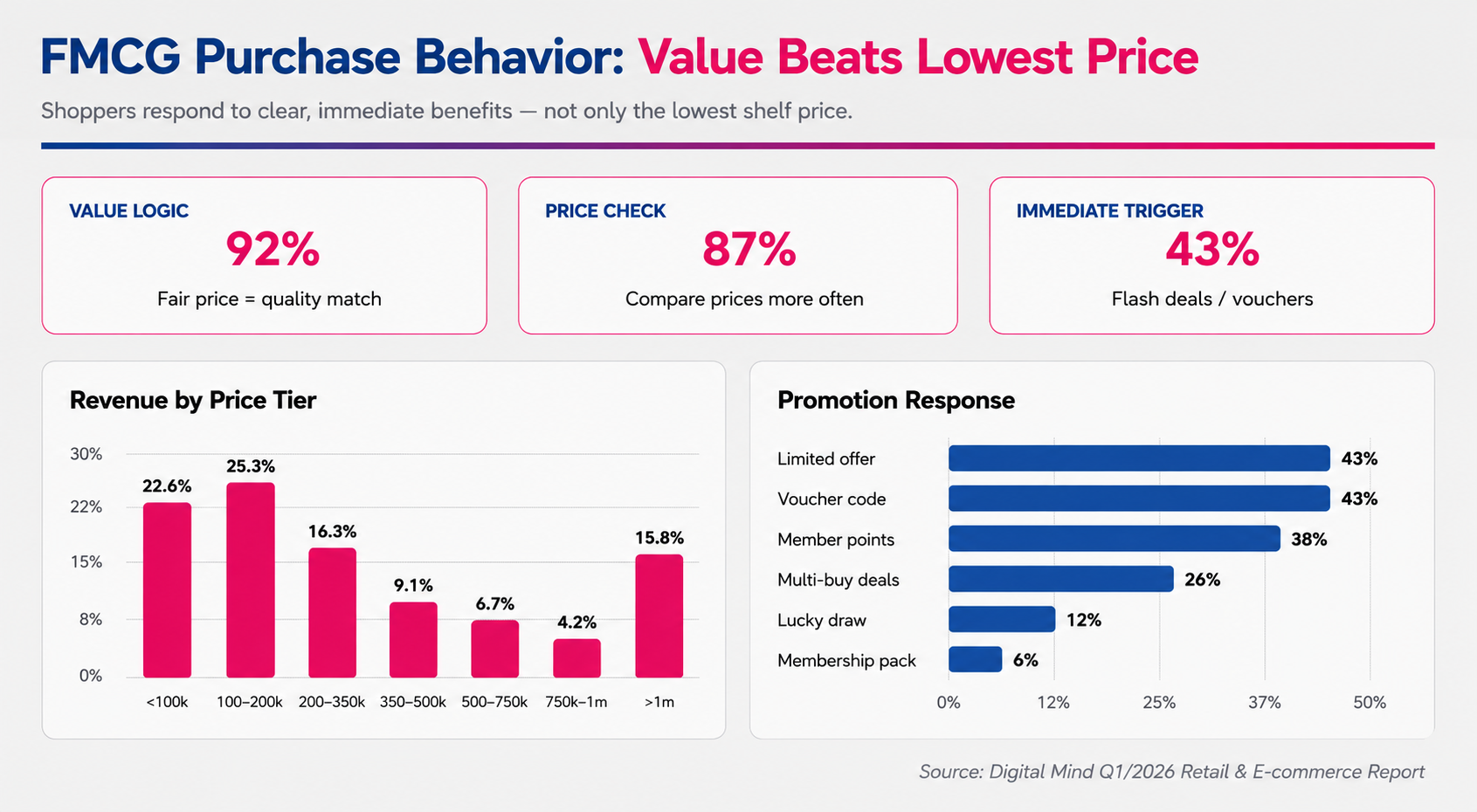
One of the most important signals for FMCG brands is the shift from price-seeking to value-seeking.
Consumers still care deeply about price, but “good price” increasingly means a fair price that matches quality. Vouchers, flash deals and direct promotions remain powerful immediate triggers, but they work best when consumers already understand why the product is worth buying.
The market’s sweet spot sits in affordable yet value-rich price bands. This is especially important for FMCG, where repeat purchase, basket-building and promotion mechanics can strongly affect revenue.
For FMCG brands, the implication is clear: discounts can open the door, but trust and value clarity close the sale.
A strong 2026 FMCG strategy should connect:
- Price-pack architecture
- Clear quality cues
- Easy-to-understand promotions
- Bundles and occasion-led packs
- Loyalty benefits that feel immediate and useful
- Strong availability across online and offline channels
Trust, quality and simplicity are becoming core purchase drivers
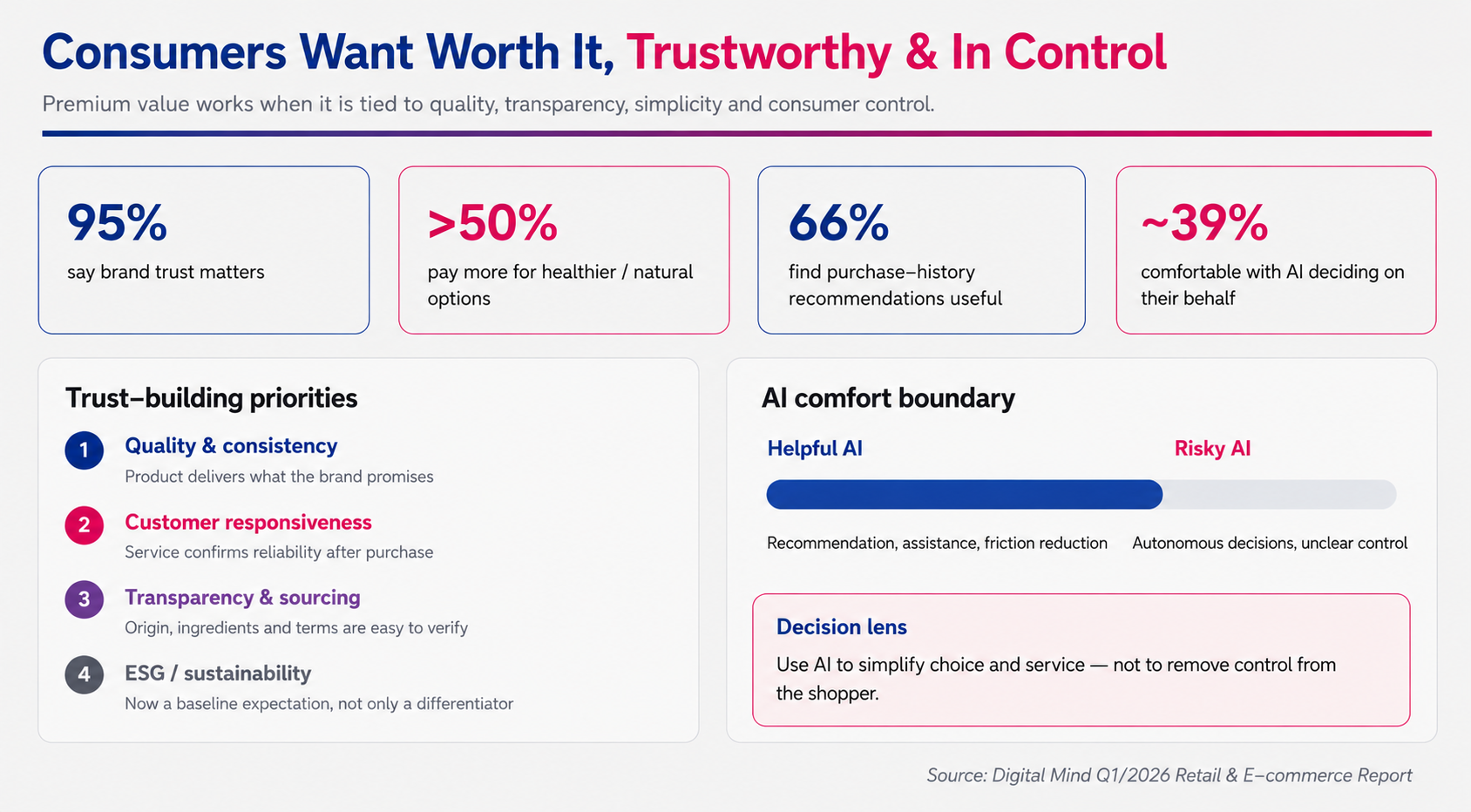
Vietnamese consumers are more quality-conscious than before. Brand trust matters, but trust is no longer built only through brand image or communication. It is built through consistent product quality, responsive service, transparency, delivery reliability and low-risk purchase experiences.
Consumers are also willing to pay more when premium value is tied to health, freshness, cleanliness, natural ingredients, traceable origin or peace of mind.
This is especially relevant for categories such as food, personal care, beauty, mother & baby, health, household products and premium FMCG.
At the same time, shoppers want less cognitive load. They want fewer confusing choices, easier comparison, simpler checkout, faster service and clearer after-sales support.
This is where personalization and AI can create value — but only when they reduce friction without taking control away from the consumer.
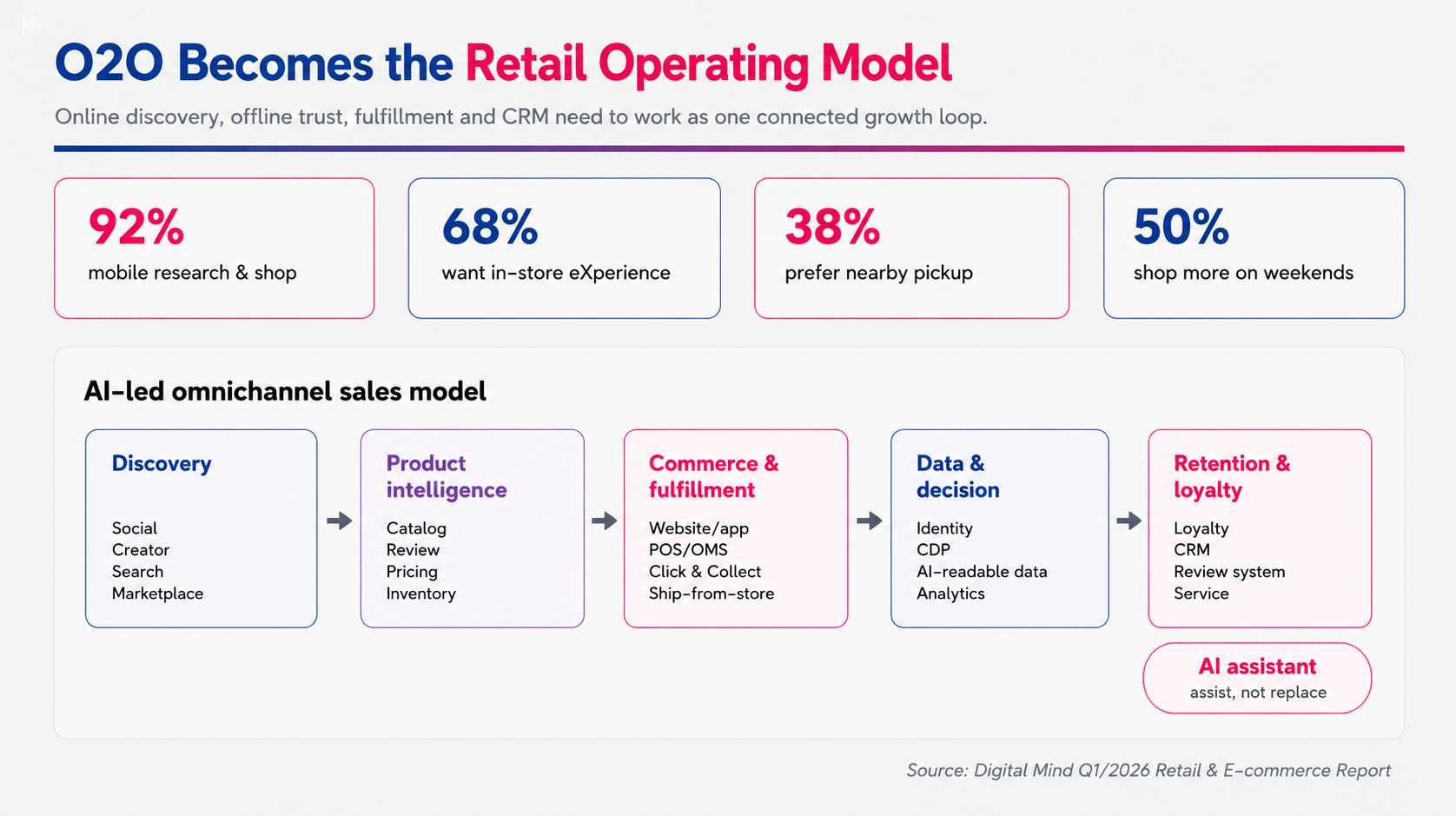
O2O is becoming the new operating model for retail growth
The old debate of online versus offline is becoming less useful.
Online is now a major touchpoint for discovery, research and promotion. But offline still plays a critical role in trust, verification, immediacy and service — especially for food, essentials, high-consideration categories and shoppers who want to see or pick up products directly.
This is why O2O and omnichannel models are becoming increasingly important.
Consumers may discover a product on social, compare it through search, check availability online, visit a store to verify quality, use a voucher in-app, pick up in-store, and later receive CRM follow-up or loyalty benefits.
For brands and retailers, this requires more than running both online and offline channels. It requires a connected operating model:
- Product information must be consistent across touchpoints
- Promotions must be coordinated across marketplace, app, store and CRM
- Stores need to support pickup, return, consultation and trust-building
- Customer data needs to connect online behavior with offline transactions
- Post-purchase service needs to support repeat and loyalty
The next stage of retail growth will be less about adding more channels and more about connecting the channels into one measurable growth loop.
30 April–1 May and summer 2026: demand will be occasion-led
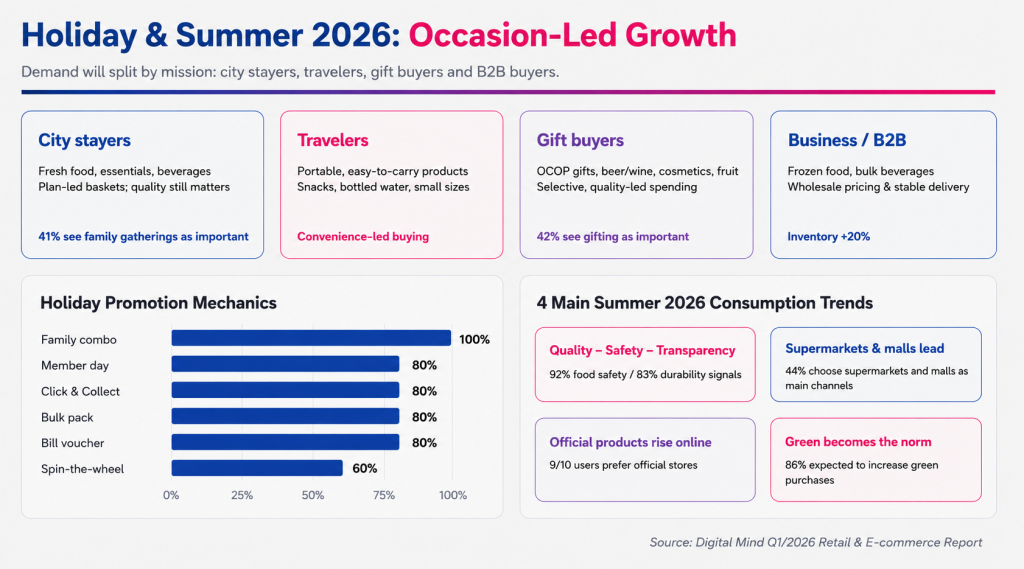
The report also looks at the 30 April–1 May holiday and summer 2026 consumption outlook.
Demand during this period is expected to be driven by occasions rather than everyday consumption alone. Fresh food, beverages, BBQ/picnic, travel-related purchases, gifting and convenience-led baskets are likely to benefit from family gatherings, domestic travel and short-term seasonal needs.
For retailers and FMCG brands, the opportunity is not only to discount more. It is to design around shopper missions.
City stayers may focus on essentials, family meals and planned purchases. Travelers may prioritize portable, easy-to-carry and convenient products. B2B buyers may need wholesale pricing, stable delivery and bulk supply. Gift buyers may look for practical, health-oriented or locally meaningful products.
This means marketing and trade plans should be built around occasions, not only categories.
What brands should act on now
For Marketing Managers and Directors in Retail and FMCG, the Q1/2026 signals point to five immediate planning priorities.
First, review the role of each sales channel. Shopee, TikTok Shop, owned e-commerce, social commerce and offline stores should not carry the same job. Each channel needs a clear role in discovery, conversion, fulfillment, repeat or loyalty.
Second, redesign content around trust and conversion. Short-form video, livestream, KOL/KOC and affiliate content should not only generate awareness. They should answer product questions, reduce risk and make the next step easier.
Third, shift promotion planning from discount depth to value clarity. Flash deals and vouchers still work, but they should be tied to clear price-pack logic, bundles, occasions and immediate customer benefits.
Fourth, use O2O to turn digital demand into store-level conversion. Click & Collect, ship-from-store, store pickup, member days and location-based search can connect online discovery with offline action.
Fifth, prepare for summer through occasion-led baskets. Instead of selling products in isolation, brands should build travel kits, family combos, BBQ/picnic bundles, freshness-led packs and convenience formats that match real consumption moments.
How Digital Mind can support
Digital Mind works with businesses that need to connect market understanding with practical execution.
We support brands across e-commerce and O2O consulting, multichannel communication, digital marketing, CRM automation, marketing automation, chatbot systems, website/app development and campaign implementation.
Our role is not only to help businesses look more digital, but to help them build clearer data, stronger customer journeys and more measurable growth systems.
Download Research Paper
Get full access to this research document